On 19 November 2026, the International Court of Justice found Myanmar responsible for the crime of genocide against the country’s ethnic Rohingya. Hate speech — expression that demeans people’s group identities — has always played a major role in laying the ground for systemic discrimination and organised violence against targeted communities. The Rohingya Genocide is no exception. Drawing from the ICJ Judgment, the following table shows how the hate propaganda playbook was applied in Myanmar.
Sources: “Stages of Hate Propaganda” adapted from Covering Hate Speech: A Guide for Journalists by Cherian George (UNESCO, 2024). “Hate Speech in Myanmar” from ICJ Judgment, Genocide case against Myanmar
| STAGES OF HATE PROPAGANDA | HATE SPEECH IN MYANMAR |
|---|---|
| Othering | |
| People’s group identities can be strong but they are also overlapping and fluid. Political actors try to fix and essentialise a chosen identity — making it seem distinct and permanent — and persuade an in-group that this identity (such as nationality) matters more than other identities (e.g. shared humanity). They thus construct a deep us/them divide. | The Commander-in-Chief of the military, Senior General Min Aung Hlaing, characterised the Rohingya (a name he rejected) as Bengalis imported during the colonial era, alien to the local population in Rakhine and the rest of the country. (Page 54) |
| Scapegoating | |
| Us-them distinctions can be innocuous. But they turn toxic when an out-group is unfairly blamed for the in-group’s problems. The in-group may have genuine grievances; it is the assignment of blame that involves distortion and disinformation. | The military’s Commander-in-Chief labelled the Rohingya as insurgents and terrorists. Rohingya militants (ARSA) had attacked police and army units, but the Rohingya in general were stigmatised as a violent threat to other ethnic groups. He called it the “Bengali problem”. (Page 54-55) |
| Dehumanisation | |
| The more the humanity of others is diminished, the easier it is to persuade the in-group to accept and participate in human rights abuses against them, and for bystanders to look the other way. The most obvious tactic is to compare the out-group to animals. | The military’s Facebook network regularly called Rohingya “animals”. (Page 56) |
| Threat inversion | |
| Most in-group members do not want to think of themselves as aggressors, or outsiders to see them that way. This is where threat inversion comes in. The in-group tells itself and the world that it is the victim and that the targeted out-group is an existential threat. This allows it to frame its actions as self-defence. | The military’s Commander-in-Chief described other communities living with the Rohingya as minorities needing protection from terrorist acts. Military training material warned that Buddhism would be swallowed up by Bangladeshi Chittagonian Indian Muslims — referring to Rohingya. The military’s network of social media accounts claimed Buddhists/Burmese were threatened by Rohingya’s terrorism, rape, Islamisation, and rampant breeding. The Rohingya were said to have a systematic plan of jihad to replace Buddhist/Burmese people. (Page 56-57) |
| Call to collective action | |
| Incitement to violence is a direct, even if coded, appeal to followers to act out against the targeted community. This is the climax of hate propaganda campaigns. Calls to action are carefully timed. Leaders look out for — or manufacture — opportune moments when emotions are high and their rallying cries will have maximum impact. | Posts on the military’s Facebook network said things like this: “[W]e don’t hesitate to punch you till your teeth fall out! .. If you say you love the Myanmar land so much, you can get a six-foot pit [a grave].” In one video, a soldier said the army had come with weapons and the spirit “to attack these animals”. He said to non-Rohigya bystanders, “[I]f you can carry a sword, then carry a sword, if you can carry a stick, then carry a stick. Carry whatever you can and bravely face these animals.” In another post titled “How have you prepared to face Jihad?”, the audience is told, “I want you to sharpen even the knives at home that you do not use.” (Page 57) |
| Negation | |
| The “final solution” of genocide is not the ultimate step in hate propaganda campaigns. Violence against weaker groups often earns the aggressor moral and legal sanction. Therefore, perpetrators of mass atrocity crimes and their supporters invest effort in denying or diminishing what happened. Negationism could take the form of denying that the victims constituted a significant social identity in the first place. | The ICJ judged that “the Rohingya of Myanmar constitute a distinct ethnic group”. The government had denied that there is such a thing as the Rohingya race, claiming that they are Bengali aliens. Long before the the genocide, Myanmar told the UN that “Rohingyas do not exist in Myanmar either historically, politically or legally”. The ICJ countered that Myanmar’s use of the term “Bengalis” shows that Myanmar also considers them to be a distinct group, for the purposes of the Genocide Convention. (Page 49, 54, 101-102) |
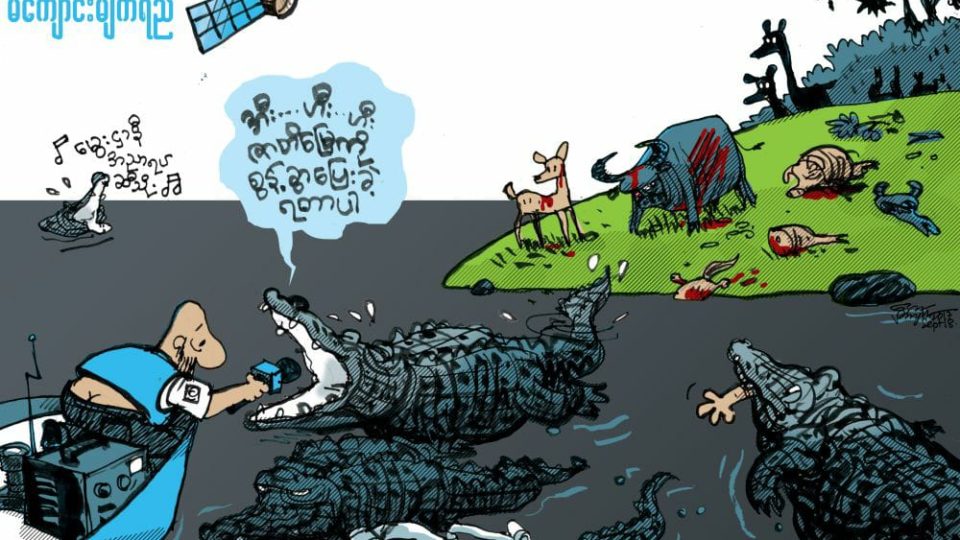
This cartoon, which appeared in a mainstream Myanmar newspaper, contains several of the tropes found in hate propaganda campaigns. Rohingya people are represented as crocodiles, not only to dehumanise them but also to depict them as dangerous. The Myanmar population are the victims here, in a classic case of threat inversion (or what the Rwanda genocide prosecutors called “accusation in a mirror”). Instead of siding with the true victims, global attention — represented by the reporter in the corner — is shown as distracted and duped by the wily Rohingya. Many of the cartoons and memes circulated in the Myanmar military’s Facebook network had similar themes, accusing the international community and foreign media of being tricked by Muslim terrorists while the Burmese people were being killed. This cartoon appears in a chapter on hate speech in Red Lines: Political Cartoons and the Struggle against Censorship by Cherian George and Sonny Liew.
Further reading on hate speech in Myanmar
- Auethavornpipat, Ruji. 2023. ‘Hate Speech and Discrimination as Mundane Violence against Rohingya Refugees during Covid-19’. Global Responsibility to Protect 15 (2–3): 177–208. https://doi.org/10.1163/1875984X-20230004.
- Beauchemin, San. 2026. ‘What’s in a Name? The Discursive Logic of Identity Erasure and Genocide Denial’. In Politics of Denial and Non-Recognition of Genocide: The Case of the Rohingya, edited by Nasir Uddin, Palash Kamruzzaman, and Bayes Ahmed. Springer Nature. https://doi.org/10.1007/978-981-92-2766-2_2.
- Independent Investigative Mechanism for Myanmar. 2024. Anti-Rohingya hate speech on Facebook: Content and network analysis. United Nations. Summary. Full.
- Lee, Ronan. 2019. ‘Extreme Speech in Myanmar: The Role of State Media in the Rohingya Forced Migration Crisis’. International Journal of Communication 13:3203–24. https://ijoc.org/index.php/ijoc/article/view/10123/2718.
- Schissler, Matt. 2025. ‘Beyond Hate Speech and Misinformation: Facebook and the Rohingya Genocide in Myanmar’. Journal of Genocide Research 27 (3): 445–70. https://doi.org/10.1080/14623528.2024.2375122.