The global resistance against division and hate
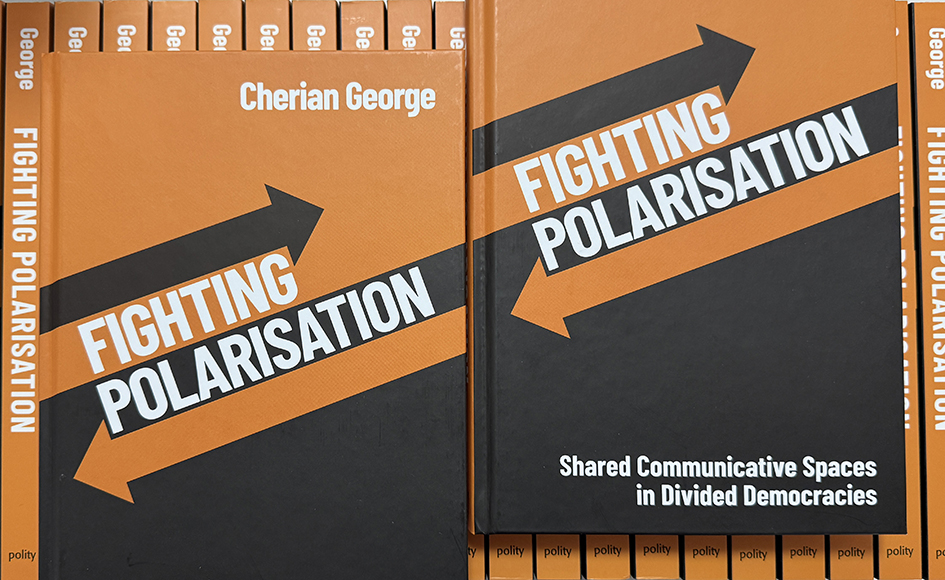
Fighting Polarisation: Shared Communicative Spaces in Divided Democracies
By Cherian George
Published by Polity, 2025.
For the latest information about talks please visit the home page of this website.
Polarisation has consumed democracies all over the world, trapping citizens in uncompromisingly opposing camps. It’s tempting to conclude that us-them enmity is just the natural order of things. But in this book I meet people around the world who refuse to give up on the democratic promise of a larger “we”; they see influential leaders, news media, and social media exaggerating division and conflict in the societies they know and love. To counter these polarising forces, members of this global, eclectic resistance build shared communicative spaces at the grassroots, not to impose a consensus but to allow citizens to practice reciprocal respect for difference.


My tour of these efforts is international, multi-sectoral, and interdisciplinary, drawing from literatures ranging from deliberative politics and postcolonial theory to religious studies and memory studies. I start with deliberative pedagogies on American campuses. Even as universities were being torn apart by war in Gaza, Zionist and pro-Palestinian students gathered privately to practise civil dialogue. In a chapter on media, I describe how journalists in post-civil-war Sri Lanka have come together to tell stories that transcend ethnic divides. My chapter on social media describes experiments testing pro-social innovations that could radically reduce the polarising effect of today’s platforms. I visit interfaith peace workers in India and Indonesia — where, for example, an ingenious community worker organised money-saving grocery runs to the “other” side to unite mothers separated by sectarian violence.
Another chapter is devoted to co-governance mechanisms in New Zealand, which help bridge the divide between indigenous peoples and dominant settler communities. Historical monuments of racism have been highly inflammatory, but my case studies of South Africa and the United States show how memory is multidirectional, allowing monuments to serve as spaces for reconciliation. In the realm of electoral politics, grassroots projects in the US and Türkiye are helping to bypass partisan polarisation by activating communities whose interests are usually overlooked in national inter-party competition. Finally, the book looks at democratic innovations in Europe, where citizens’ assemblies gather mini-publics to deliberate on contentious issues, with remarkably counter-polarising effects.
These diverse projects share two key attributes. First, they are not content with top-down negotiations where elite representatives settle disagreements on behalf of passive publics. They promote grassroots dialogue and deliberation. Second, they reject conventional wisdom that division and conflict are inevitable since human nature is brutish and tribal. They believe it is possible to build social bonds that cut across us-them divides. This is a global movement led by community organisers, parliamentarians, journalists, tour guides, farmers, teenage college students, and mothers. Many people observing — and suffering — the toxic impact of polarisation believe that resistance is futile. No. It is possible to fight back, and this book offers proof.

Publisher’s page.
Order a copy here (UK) or here (US).
In Singapore, get the book at Kinokuniya. Click on Store Stock Status to check availability at different branches.
If you are an instructor who may want to adopt this title for your course, you can request a digital inspection copy here.
Also see:
“How to fight polarization”– Journal of Democracy
“A Better Model for Campus Dialogue” – Inside Higher Ed
Praise for Fighting Polarisation
An invaluable contribution to those who seek to reclaim our shared humanity amid intensifying hate. It presents a raft of depolarising initiatives, some recent, some decades old, but all tested for when and how they are impactful. A liberating and empowering read!
Ahmed Shaheed, Professor of International Human Rights Law, School of Law and Human Rights Centre, University of Essex
In this easy-to-read and timely book, Cherian George tackles tough topics such as polarisation, fascism, and ethnoreligious nationalism. The vivid case studies illustrate how community and care can serve as antidotes. Democracy, therefore, is not just electoral politics. It is the everyday practices of resistances that center deliberation, diversity, and dialogues.
Srivi Ramasubramanian, Newhouse Professor & Endowed Chair, Newhouse School of Public Communications, Syracuse University
It is rare to come across a book that simply yet powerfully speaks to our concerns, while giving hope. And doing so through sharing the stories of doable and replicable actions, effectively changing our world for the better. Fighting Polarisation is a new book detailing stories of successes of countering polarisation, by engaging with adversaries to build communicative spaces.
Azza Karam, President and CEO, Lead-Integrity, and member of the United Nations’ Secretary General High Level Advisory Board on Multilateralism.
The book is brilliant in its design as a research project. And impressive in its empirical scope, covering as it does many parts of the world and polarization that takes different forms. The book activates a sense that being alive in the world means being part of something larger than the self.
Teo You Yenn, Director, Centre for the Study of Social Inequality, Nanyang Technological University.